The VA Is Now Using Artificial Intelligence to Process Your Disability Claim. Here Is Why You Need a Lawyer.
VA AI claims processing is changing fast, and most veterans have no idea. The federal agency that handles your disability claims is quietly rolling out artificial intelligence tools to process, sort, and now flag your benefits paperwork. And the legal landscape for veterans has changed because of it.
Got a denied or underrated VA claim? Chase Villeret is a VA-accredited attorney who helps Louisiana veterans appeal VA decisions, including supplemental claims and higher-level reviews. Get a free case review or call (985) 327-2601.
If you’ve filed a VA disability claim, appealed a denial, or submitted a Disability Benefits Questionnaire (DBQ) from a private doctor in the last few years, this affects you. Here is what you need to know about the VA AI claims processing, and why having an accredited VA attorney, like Chase Villeret, by your side has never mattered more.
What Is VA AI Claims Processing and How Does It Work?
In January 2026, the U.S. Department of Veterans Affairs published its formal AI adoption strategy, titled “Building the Future: VA’s Strategy for Adopting High-Impact Artificial Intelligence.“ The document is not speculative. It is a blueprint already being executed.
The VA’s stated vision includes using AI to deliver benefits in “minutes not months,” automate document intake and classification, generate preliminary adjudications, and deploy AI-powered virtual assistants to handle veteran inquiries. As of fiscal year 2025, the VA has already processed a record 3,001,734 disability and pension claims, in large part because of new VA AI claims processing tools.
Speed and efficiency are real benefits. But speed cuts both ways. When AI is making or informing decisions about your benefits, mistakes are faster too, and they can be harder to fight.
The DBQ Fraud Scan: What Veterans Need to Understand Right Now
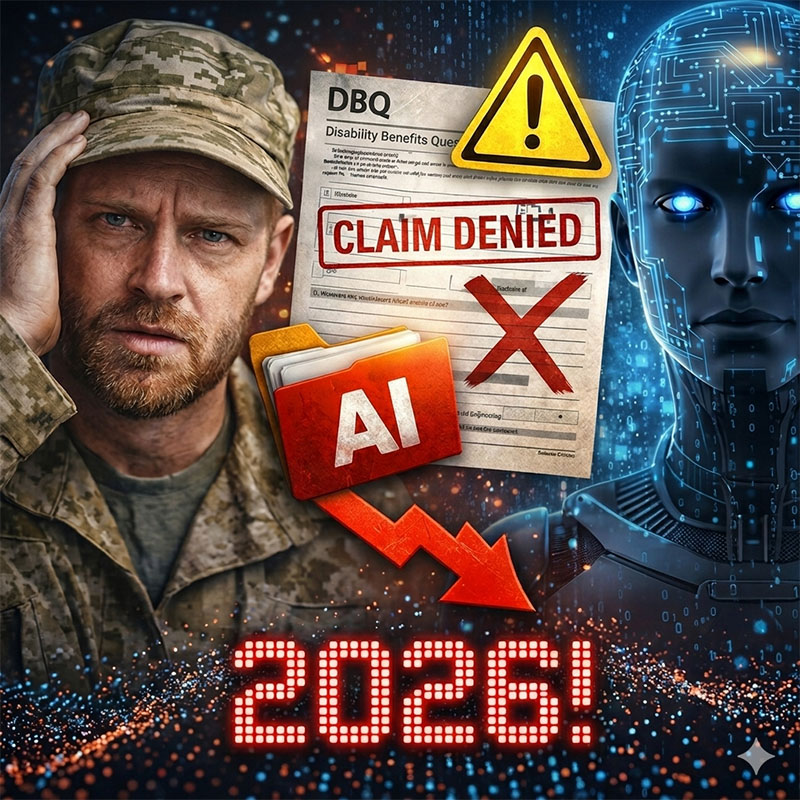
The most alarming development to emerge in early 2026 is the VA’s plan to deploy a data analysis tool (powered by Microsoft Power BI with AI integration) to scan more than one million Disability Benefits Questionnaires (DBQs) going back to 2010.
DBQs are the medical forms your doctor fills out to document the severity of your service-connected condition. They are a cornerstone of most VA disability claims. The VA says it is building this tool to identify organized fraud rings: third-party companies that file fraudulent DBQs and charge veterans exorbitant fees. That’s a legitimate concern.
But here’s the problem: the new VA AI claims processing tool will flag DBQs based on automated pattern-matching, including:
Boilerplate language: Repeated or similar phrasing across forms, even if it’s standard medical terminology
Provider distance: A doctor located more than 100 miles from the veteran’s home, even if the veteran used telehealth or traveled for a specialist
Missing fields: Incomplete information in signature blocks, even if clerical
Altered documents: Any signs of modification, regardless of whether they were legitimate corrections
⚠️ What Happens If Your DBQ Is Flagged
If the VA’s tool flags your DBQ, you will likely be required to undergo a new Compensation and Pension (C&P) exam. This adds delay, renewed scrutiny, and real risk to your benefits, even if you did absolutely nothing wrong. According to a 2023 VA Inspector General report, automated tools used in claims processing already produced errors in roughly 27% of reviewed records.
There will be some fraud found, but a lot of DBQs will be questioned that may not be fraud.
Jason Cameron, Marine Corps veteran & retired VA benefits service officer, Stars and Stripes, March 2026Major veterans advocacy organizations, including the Disabled American Veterans (DAV) and the Military Officers Association of America (MOAA), have formally raised concerns about due process and the risk of legitimate claims being caught in the net. The DAV has directly demanded that the VA explain how the tool works, how it was validated, and what rights veterans have if their file is flagged.
The Deeper Problem: AI Decisions Are Hard to Challenge
When a human rater denies your claim, you have a paper trail. You know what evidence was weighed. You can contest the reasoning. You can appeal.
With the new VA AI claims processing strategy, an algorithm flags your claim, the logic may be opaque, sometimes deliberately so. Veterans already face steep odds in appeals. Adding an AI layer makes the path even more difficult to navigate without expert guidance.
As one legal commentator noted in Rolling Stone: “A claim flagged by an algorithm is not proof of fraud. But once a system marks a DBQ as potentially problematic, the veteran is no longer simply filing a claim. They are defending themselves against an invisible accusation.”
This is precisely the kind of situation where having an accredited VA lawyer, not just a claims agent or a for-profit “VA claims company”, makes a decisive difference.
Why an Accredited VA Attorney Is More Important Than Ever in the AI Era
What a VA Disability Attorney Does That AI Cannot
-
- Reviews your entire claims file with legal knowledge of what triggers favorable and unfavorable outcomes, not pattern-matching
- Ensures your documentation is airtight before submission, reducing the chance of being flagged by automated systems
- Understands your due process rights if your claim is flagged, delayed, or denied based on AI-assisted review
- Represents you in appeals before the Board of Veterans’ Appeals (BVA) and the U.S. Court of Appeals for Veterans Claims (CAVC)
- Identifies service-connected conditions you may not have claimed, ensuring you receive every benefit you’ve earned
- Cannot be replaced by a chatbot, a claims company, or an unaccredited representative. Only accredited attorneys and VSOs have the legal standing to represent you before the VA at every level
The VA’s own AI strategy acknowledges that AI tools are designed to assist staff, “not replace trained claims processors.” But as VA AI claims processing expands, the margin for error grows with it. When the new tools make an error that affects your rating, your monthly compensation, or your access to healthcare, you need someone in your corner who knows the law.
A Note on Unaccredited “Claims Companies”
The same AI fraud-detection push that is alarming veterans was specifically designed to target unaccredited, for-profit companies that charge veterans to file or boost claims. These companies are now under federal scrutiny. The GUARD VA Benefits Act is advancing in Congress to criminalize their most predatory practices.
If you’ve used one of these companies in the past, your DBQ may already be in the review pool. If you’re considering one now, understand the risk. An accredited attorney is held to a strict ethical and legal standard. A claims company is not.
Frequently Asked Questions About VA AI and Your Disability Claim
Your Benefits Were Earned. Don’t Let an Algorithm Take Them.
The VA’s use of artificial intelligence is real, it’s growing, and it changes what it means to fight for your claim. Villeret Law is here to make sure you have a human advocate with legal expertise in your corner when it comes to dealing with the new VA AI claims processing tool.